
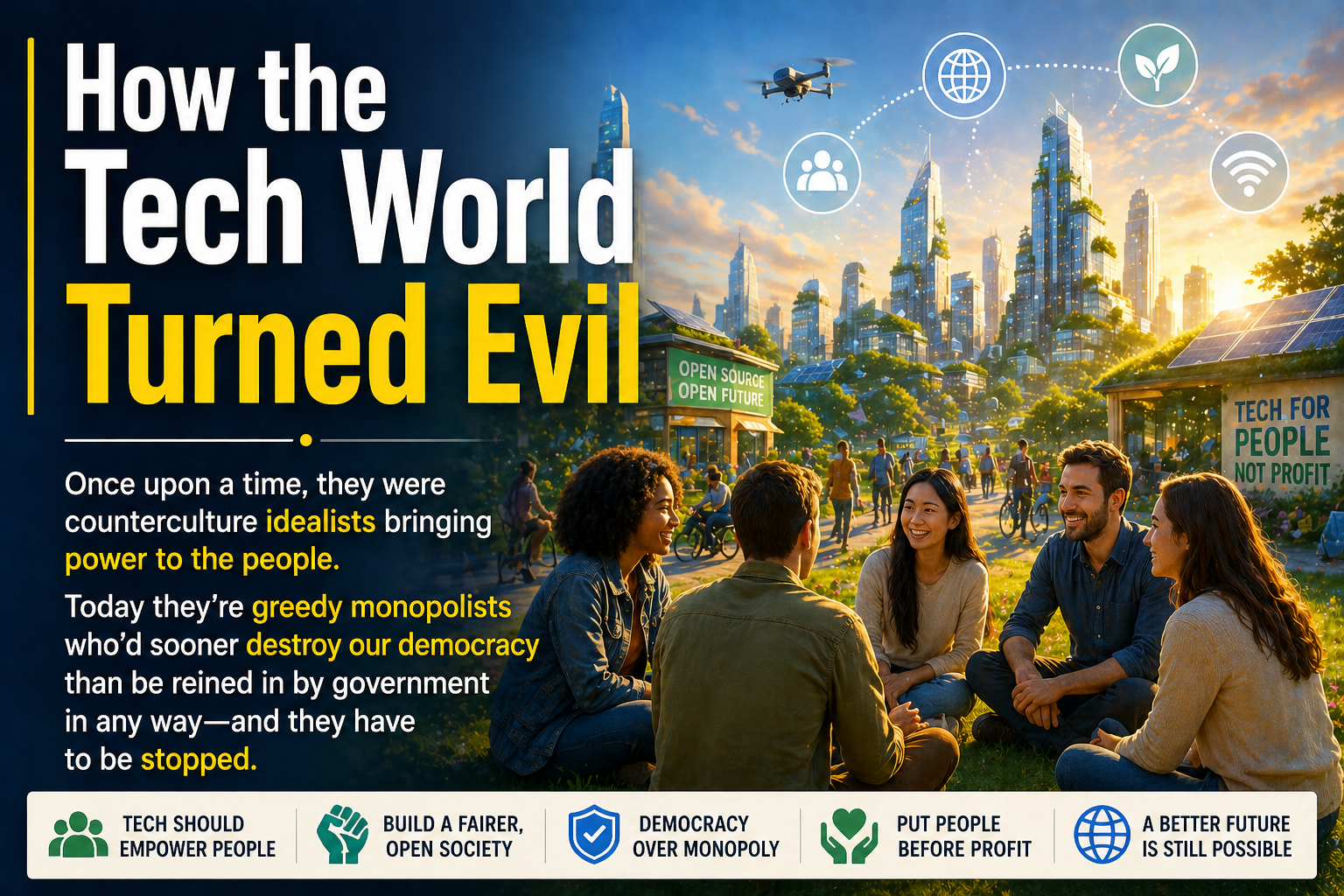
How the Tech World Turned Evil – From Counterculture Idealists to Greedy Monopolists
Remember the early days of tech? A bunch of idealistic hackers in garages and university dorms, dreaming about how technology could break down barriers and give power back to the people. They weren’t just building tools—they were starting a revolution. Fast forward to now, and the giants they helped birth look more like corporate overlords guarding monopolies with an iron fist.
It’s a pattern as old as business itself: once a company grows beyond a certain size, the idealism fades. Profit and control become the new gods. What’s striking, though, is how these tech behemoths wield their power—not just in the marketplace but also aiming to shape policy and democracy itself. The relentless pushback against regulation isn’t just about protecting revenue streams; it’s about maintaining a stranglehold on influence.
Take Facebook (now Meta) for example. It began with a mission to “connect the world,” which sounded great until it morphed into a platform where misinformation spreads unchecked and user privacy is commoditized. The Cyberpunk genre, often dismissed as dystopian fantasy, has in many ways already become our reality—where technology no longer liberates but surveils and manipulates.
In the absence of a unified community response (as seen in Hacker News or Reddit), the real challenge lies in actionable checks and balances—things like enforced transparency, antitrust actions, and reinventing business models around ethical incentives. Because without intentional limits, this “evil” is just business as usual, and that’s a hard pill to swallow.
Introduction: The Rise and Fall of Tech Idealism
The tech world wasn’t always the Goliath we grumble about today. Remember the early days—garage startups with scruffy founders who genuinely believed they could change the world? That idealism was real, and it felt electric. Companies like Apple and Google started with a vision of empowerment, democratizing information and making technology accessible to everyone. But somewhere along the line, things shifted.
There’s a raw truth lurking beneath this story: as firms grow, they often shed their idealistic skin and don the cloak of monopoly and greed. It sounds cynical, but look at the pattern—Facebook’s spiral from a quirky social network to a giant accused of undermining elections, or Amazon’s empire that started by helping small bookstores and now crushes them underfoot. This isn’t just hyperbole; it’s a theme echoed by countless on forums and in the undercurrent of tech conversations, even if not always explicitly outlined.
The Cyberpunk genre, often dismissed as dystopian fiction, eerily predicted this trajectory. What started as a push for “power to the people” twists into a nightmare where mega-corporations dominate every aspect of life. That’s not a coincidence—it’s almost like a warning flashing in neon lights.
Tech idealism wasn’t naive; it was a promise. Sadly, it’s one we’re still waiting for these giants to live up to.
The Dream That Sparked It All
It’s hard not to feel nostalgic when thinking about the early days of tech. Back then, the pioneers—those scrappy visionaries working in garages or late-night dorm rooms—were more than just coders or entrepreneurs. They were, in many ways, counterculture idealists. Their goal wasn’t just to build cool gadgets or apps; it was to decentralize power, break down old hierarchies, and democratize information. The internet’s promise wasn’t just connectivity but freedom—freedom to create, express, and innovate without big gatekeepers standing in the way.
Take the early ethos behind companies like Apple and Microsoft. Steve Jobs and Bill Gates weren’t just chasing profits initially; they wanted to put a personal computer on every desk, to empower individuals rather than corporations. Even the creators of the World Wide Web set it up to be open and accessible, believing knowledge should be free. That’s a big contrast to the giant data-driven monopolies we see today.
It’s no surprise, then, that folks often point to the Cyberpunk genre as a sort of eerie prediction of the present: a future where technology, once a tool for liberation, becomes a tool for control and corporate greed. It captures the tension between innovation and exploitation perfectly.
In short, the original vision was clear—tech was supposed to be a force for good, an equalizer. Somewhere along the way, that dream got tangled up with unchecked growth and money, leaving many of us wondering how things went so wrong.
The Rise and Fall of Tech’s Counterculture Dream
Once upon a time, the tech world wore its idealism like a badge of honor. The early pioneers saw themselves as rebels—countercultural heroes meant to upend old power structures and hand tools for freedom directly to the people. Think of the whole Silicon Valley mythos in the ’70s and ’80s: garages, open source, and a mission to democratize knowledge and opportunity. They weren’t just coding—they were reshaping what society could look like.
Fast forward a few decades, and that same spirit feels almost like a distant memory. The companies born from those idealistic roots have grown into sprawling empires obsessed with growth, market domination, and, ultimately, shareholder value. The cyberpunk genre, which some dismiss as dystopian fantasy, actually nailed where we’re headed—a world where tech giants wield monstrous power and privacy is just a commodity to exploit.
There’s a well-worn saying that when companies get too big, they “turn evil.” It’s not about some moral failing; it’s about incentives and scale. Once you’re a giant with billions on the line, it’s easier to bulldoze democracy or ignore government checks than to actually cooperate. Take Facebook, for example. What started as a platform for connection swing-shifted into an unregulated behemoth with the power to influence elections and control information flow globally. The idealism didn’t disappear overnight—more like got worn down, buried beneath quarterly earnings calls and the relentless pursuit of monopoly.
It’s a cautionary tale that wasn’t hard to see coming, yet somehow still surprises us. The challenge now is figuring out how to wrestle these giants back without losing everything that tech once promised.
Why This Shift Matters for Society and Democracy
There’s something deeply unsettling about watching the tech giants morph from counterculture heroes into monopolistic powerhouses unwilling to be held accountable. It’s not just a business evolution—it’s a societal earthquake. At the start, these companies promised empowerment, freedom of information, and democratized innovation. But today, their unchecked growth has led to behaviors that feel almost dystopian, echoing the very Cyberpunk nightmares some of us feared coming true.
Why should you care? Because when a company’s priority shifts solely to protecting its dominance and revenue, democracy takes a hit. These firms control vast amounts of personal data, influence public discourse, and sometimes quietly decide which voices get heard—or silenced. It’s not paranoid conspiracy stuff; it’s a real challenge for transparency and fairness.
Take Facebook (now Meta) as a prime example. What began as a platform to connect people evolved into an advertising behemoth whose algorithms can amplify misinformation and polarize societies. This shift didn’t just hurt users; it rattled democratic processes worldwide, leading to calls for serious regulation.
So, this isn’t about blocking progress but about ensuring the tech world’s power doesn’t undermine the very freedoms it once championed. When companies get too big and too powerful, history suggests they tend to act in their own interest first—which means the rest of us have to keep a close eye on them before it’s too late.
The Origins of Tech Counterculture: Power to the People
It’s hard to overstate just how revolutionary the early tech counterculture was. Back in the day, the internet and tech startups were less about fattening wallets and more about empowering individuals. The vision was clear: decentralize authority, challenge corporate dominance, and put tools in the hands of everyday users. Think of it as a digital version of the ’60s counterculture, but with code instead of protest signs.
This wasn’t simply idealism; it was practically enshrined in the hacker ethos—hack to learn, share openly, and disrupt centralized power. Early open-source projects like Linux or the initial days of the Web were rooted in this philosophy. They believed technology could act as a great equalizer.
Yet, anyone who’s observed the transition from those idealistic days to present times can’t help but notice a shift. There was always a tension between growth and maintaining values. A community member once pointed out that as firms grow beyond a certain scale, “they always turn evil.” It’s a cynical take, but it captures a truth: incentives change when your company goes from scrappy startup to corporate giant with shareholders breathing down your neck.
For example, Google started as a scrappy search engine aiming to organize the world’s information; now, it’s practically a gatekeeper deciding who sees what, prioritizing profits and control over openness. This transformation illustrates the fall from idealistic beginnings to monopolistic dominance—setting the stage for today’s concerns about tech giants undermining democracy.
Early Tech Innovators and Their Anti-Establishment Ethos
Back in the day, the tech world was a playground for rebels. The founders of many of today’s giants didn’t start out aiming for dominance; they were counterculture idealists, hacking away in garages and basements with a mission to democratize technology. The story of Apple’s early years exemplifies this—Steve Jobs and Steve Wozniak crafting computers that would put power in the hands of everyday people rather than corporations or governments.
There’s a raw authenticity in those origins. The ethos was about breaking monopolies, spreading knowledge, and fostering empowerment. Remember the early internet idealism? It was all about open access, collaboration, and decentralization. But here’s the kicker: as the tech firms scaled, many lost that ethos. Growth, profit, and domination creep in. The Cyberpunk genre—a favorite cautionary tale mentioned often in forums—captured this descent perfectly, painting a future where tech’s promise became twisted into surveillance capitalism and authoritarian control.
Interestingly, neither Hacker News nor Reddit offers new takes on these early ideals—they seem to accept this narrative as common sense. Meanwhile, the lack of relevant Stack Overflow commentary suggests tech professionals are more focused on practical problems than revisiting the movements’ original philosophies.
Ultimately, it feels like when a company grows beyond a certain threshold, its principles often erode, replaced by a drive to protect market share, even at democracy’s expense. That transition from idealism to monopolistic greed is a tough pill to swallow, but it’s not an accident—it’s baked into the system.
Key Moments and Movements That Shaped Tech Idealism
It’s wild to think about where tech started versus where it is now. Back in the day, the tech world felt like this bright, rebellious force — a kind of digital counterculture, you know? People like the early open-source pioneers and the folks in Silicon Valley saw technology as a way to *empower* individuals: democratizing information, breaking down old gatekeepers, and shaking up the establishment.
The free software movement, for example, wasn’t just about code. It was a statement: software should be open, accessible, and something people could control, not just consume. The whole ethos was “power to the people.” Same with early internet communities that embraced openness and collaboration.
But here’s the kicker: that idealism only lasts so long when companies start chasing scale and profit. One community member summed it up simply and eerily: “When a firm grows past a certain point they always turn Evil.” It’s almost like the Cyberpunk genre nailed this shift decades ago—tech moving from liberators to oppressors, richly capitalizing on centralized control.
Think about Facebook (now Meta). It started as a college network with a “connect everyone” vibe, but it quickly morphed into a massive ad-driven empire influencing everything from politics to personal behavior. Instead of empowering users, the company ended up holding power over them, often with scant regard for democratic values.
The takeaway? The movements that once gave us hope also set the stage for the current tech dystopia. Understanding this evolution is key to figuring out how to fight back.
How technology promised democratization and empowerment
There was a time when tech felt like a beacon of hope. The narrative was simple: these tools would break down barriers, give voice to the unheard, and dismantle existing power structures. Early internet pioneers envisioned a decentralized utopia where information was free, and anyone with a connection could participate equally. Remember the dot-com boom? It was full of idealists hacking away in garages and dorm rooms, dreaming of leveling playing fields—and for a while, it felt like they might actually pull it off.
The promise was big: technology would put power back into the hands of the people. Open-source projects flourished, social media seemed poised to mobilize grassroots movements globally, and platforms like Wikipedia showed how collective knowledge could thrive without corporate control. But—there’s always a but—those shining ideals started to fade as companies scaled. The Cyberpunk genre might have been just fiction, but to many, it tracked eerily close to reality. As tech giants grew, they morphed into monopolistic behemoths hoarding user data, controlling narratives, and wielding influence that governments could barely counterbalance.
Take Facebook in its early days. Once a college project aimed at connecting students, it ballooned into an advertising juggernaut that now shapes political discourse worldwide. The aspect of democratizing communication was hijacked by algorithms optimizing for engagement, not empowerment. So while tech began as a tool for liberation, many of us now live under systems that prioritize profit over people, a far cry from those hopeful beginnings.
The Growth of Tech Giants: From Startups to Monopolies
It’s almost a cliché now—the scrappy startup with a revolutionary idea morphing into a behemoth that feels more like a villain in a cyberpunk novel than the scrappy underdog it started as. This wasn’t what most of us signed up for when we cheered on these companies early on, hoping they’d democratize power and shake up old systems. Yet, as many have observed (including plenty of skeptics in niche corners of the internet), once a firm passes a certain threshold, it’s like a switch flips. Suddenly, the focus isn’t innovation or community empowerment—it’s monopoly power and profit maximization at almost any cost.
No one spells this out better than the critics who’ve always compared today’s reality to the Cyberpunk genre’s dystopian vision. The genre predicted our current crossroads where technology centralizes control instead of distributing it. It’s grim, but it’s also practical—history shows this pattern again and again. Take Facebook, for instance. It began as a platform to connect friends but now wields outsized influence over media, politics, and private data, often resisting any form of outside regulation.
This isn’t just paranoia; it’s the outcome of unchecked growth. Without meaningful checks, tech giants tend toward becoming monopolies that prioritize their dominance above democratic values. It’s a dangerous path, one that demands we rethink how these companies evolve and how we hold them accountable. Otherwise, that cyberpunk future doesn’t just stay fiction.
The transformation of the tech industry from visionary idealists to dominant monopolists represents one of the most alarming shifts in modern history. Initially champions of innovation and democratization, these companies have increasingly prioritized profit over principles, undermining democratic institutions and exploiting their unmatched influence to evade accountability. Their unchecked power threatens free speech, privacy, and fair competition, distorting the very society they once sought to empower. Addressing this crisis requires decisive action from governments, regulators, and civil society to enforce stronger oversight, promote transparency, and restore competitive balance. Only by holding these tech giants accountable can we preserve democratic values and ensure technology serves the many—not just the privileged few. The time to rethink, regulate, and reclaim the digital future is now; failure to act risks surrendering our democracy to the unchecked dominion of corporate greed.