
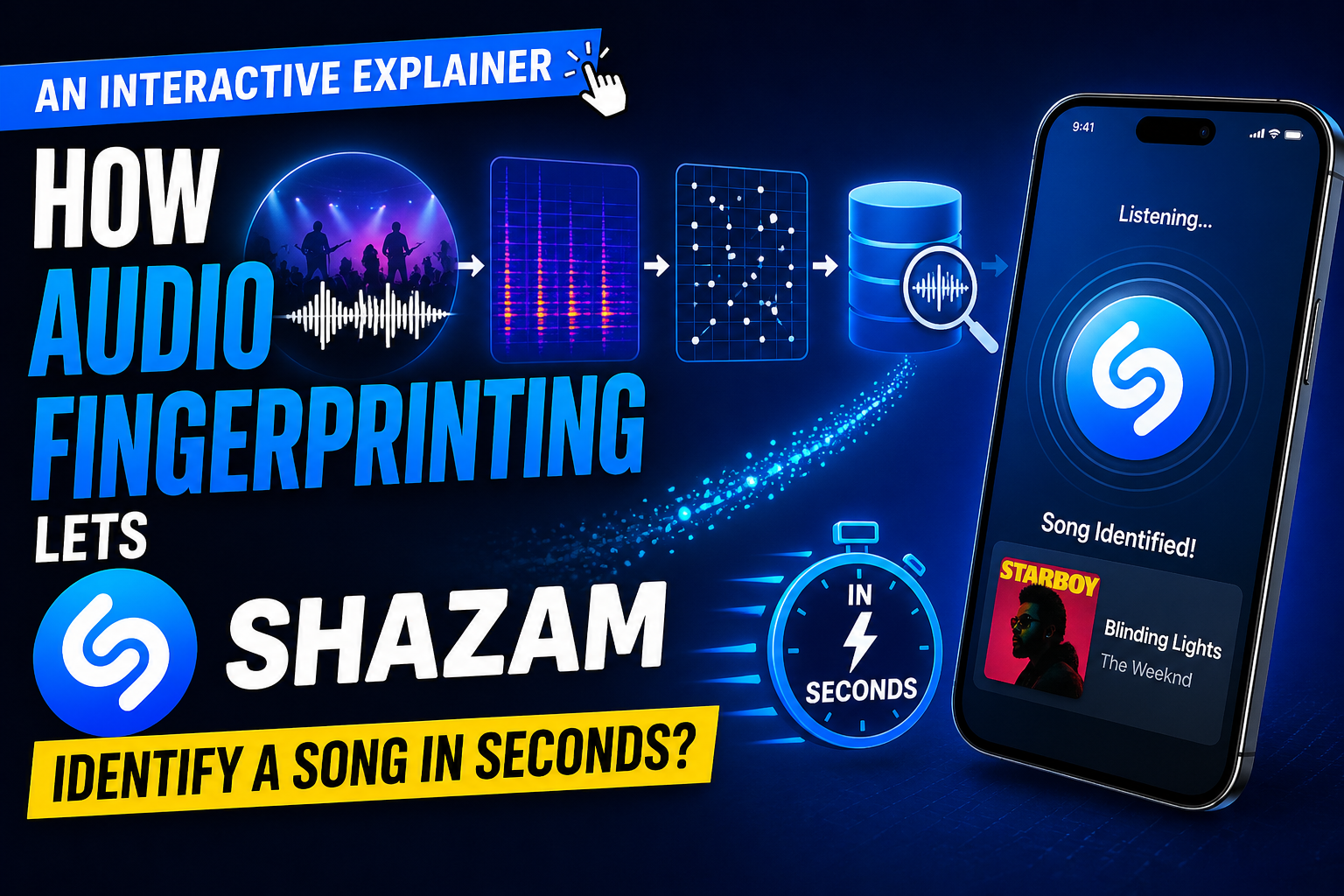
How Audio Fingerprinting Enables Shazam to Identify Songs in Seconds
Most of us have experienced that magic moment when Shazam nails the name of a song just seconds after we tap the app. It’s pretty wild when you think about it, especially because songs can overlap, have background noise, or only a snippet is available. But the secret sauce here is audio fingerprinting, a clever technique that cuts through the noise—literally.
At its core, Shazam breaks down a short clip of the song using the Fourier Transform to analyze its frequency spectrum. It then identifies distinct peaks—kind of like a sonic fingerprint unique to that moment in the song. These “peaks” become hash codes that Shazam matches against its colossal database of pre-indexed song fingerprints. Because it doesn’t rely on the whole song or lyrics, it can match fragments quickly even in noisy environments.
This approach isn’t just theoretical; back in the early days, a quirky website let you tap your spacebar to a song’s rhythm and guess what it was. That was cool but only workable for tiny datasets. Modern services, including Shazam, scale this up dramatically with huge libraries and fast lookups.
It’s a bit like matching puzzle pieces. You have this unique set of sonic markers from your clip, and the database finds exactly which song’s puzzle piece aligns perfectly. That’s why Shazam is often frighteningly fast and accurate. Next time you’re out and about and a song catches your ear, remember—there’s some serious math and massive indexed data behind that instant ID.
Introduction: The Magic Behind Instant Song Recognition
Imagine hearing a catchy tune at a coffee shop, pulling out your phone, and within seconds, discovering the song’s title and artist. That’s the everyday magic of Shazam, a technology that seems almost like wizardry to the untrained ear. But underneath this sleek user experience lies a fascinating process known as audio fingerprinting.
Back in the early days—think a decade or more ago—there were simpler tools that tried to identify songs by syncing your tapping to the beat. It was clever, but limited, usually effective only because music libraries were smaller. Fast forward to now, and the challenge has sprung up exponentially: millions of tracks, countless versions, noises, backgrounds, and less-than-perfect audio samples.
So how does Shazam pull it off? At its core, it’s about cutting the incoming audio into tiny time slices, performing a Fast Fourier Transform (FFT) on each to analyze frequencies, and picking out unique peaks. These peaks transform into fingerprints—a digital signature of that moment in the track. The genius is in how these fingerprints are mapped and compared against an enormous database. Even if you’re humming halfway through a song, Shazam zeroes in on matching patterns with remarkable speed.
One striking example comes from a music venue I once visited, where a live cover band played obscure indie tracks. Despite the ambient noise and the band’s variations, Shazam still nailed the original songs quickly. It’s proof that audio fingerprinting isn’t just theory—it’s a resilient, practical method, finely tuned for the real world.
Shazam’s Popularity: The Magic Behind That Instant Song ID
If you’ve ever been mid-conversation or stuck in a moment thinking, “What’s that song?” you probably owe a little thanks to Shazam. Its rise to popularity isn’t just because it’s handy—it’s because it feels almost magical how fast and accurately it works. Back in the early days of audio recognition, there were simpler attempts like that quirky website where you tapped your keyboard to the beat and, surprisingly, it nailed the song. Of course, that was with a tiny dataset compared to today’s giants.
What fascinates me—and a lot of people online—is how Shazam reads a tiny snippet of audio, analyzes the frequency spectrum, and then matches these “audio fingerprints” instantly to a gargantuan database. Reddit users love interactive explainers showing how FFTs (Fast Fourier Transforms) break down sound into peaks and how those peaks form hashes that Shazam then matches. Yet, it’s funny how many explanations skip the gritty middle steps, sometimes reducing it all to “and it just matches!” This black box feel makes the technology seem even more impressive.
A practical example of this tech’s smoothness: I was in a noisy café, music blasting, yet a single Shazam tap on my phone quickly identified a rare jazz tune I’d never heard before. It was impressive not just how fast it worked, but how it could read through background noise that would confound traditional methods.
While forums like Hacker News often dig into scalability challenges or algorithm efficiency, Reddit tends to celebrate the user experience and demystify the process for everyone. It’s this blend of deep tech and seamless user magic that keeps Shazam a household name today.
Why Speed and Accuracy Matter in Song Identification
When it comes to apps like Shazam, speed and accuracy aren’t just nice-to-haves — they’re everything. Imagine you’re at a coffee shop or a party, and a song starts playing that grabs your attention. You pull out your phone, open the app, and want an answer almost immediately, before the moment passes. That split-second window is what makes or breaks the user experience.
Accuracy is equally critical because a wrong identification isn’t just frustrating — it kills trust. These apps don’t just recognize a tune; they’re making a lightning-fast choice out of millions of tracks. It’s like finding a needle in a haystack but doing it blindfolded, with only a tiny piece of the needle visible.
One practical example comes from a friend who works in radio. They rely heavily on quick song ID tools to tag tracks for copyright and playlist data. If the tool mistakes a track, it results in reporting errors that affect royalties and playlist credibility. So behind the scenes, this technology isn’t just about convenience — it’s work-critical.
Thanks to methods like audio fingerprinting, which compares tiny audio “hashes” to vast databases, Shazam can identify songs within seconds with impressive precision. Without that perfect combo of speed and accuracy, users would quickly abandon these tools for something else, maybe manual searches or crowdsourced guesses, which are slow and unreliable. So yes, getting your song ID fast *and* right is the secret sauce.
Introducing Audio Fingerprinting: The Magic Behind Shazam’s Speedy Song Identification
When you tap Shazam on your phone and, within seconds, it names the song playing in the background, you’re witnessing audio fingerprinting in action—a technology that’s both elegant and surprisingly clever. At its core, audio fingerprinting is about creating a unique “signature” from a short snippet of a song, like a sonic barcode, that can be matched against a massive database in an instant.
Here’s the thing: the process starts by breaking down a few seconds of audio into tiny segments and running a Fast Fourier Transform (FFT) on each. This converts sound waves into the frequencies that compose them. The key insight isn’t just about analyzing every single frequency but focusing on the peaks—the loudest or most distinctive points in the spectrum. These peaks become anchors, generating hashes that represent that precise moment in the song.
What makes it fascinating is how little audio you need. Shazam doesn’t listen to the whole track; a few seconds is enough. It then searches its vast indexed database of these hash pairs and their timestamps, aligning them to find the best match even if the recording is noisy or partial.
I remember trying an old website years ago that let you tap the spacebar to the beat of a song and would figure out what it was. It worked pretty well but nowhere near the scale or precision of Shazam’s approach, which thrives thanks to its sophisticated hashing and a gargantuan music index.
In many ways, audio fingerprinting is a triumph of thoughtful simplification—extracting just the right features to create a compact but unique identifier that is lightning-fast to compare across millions of songs. It’s these smart algorithmic choices that let Shazam feel like magic.
What is Audio Fingerprinting?
If you’ve ever wondered how Shazam or similar apps can identify a song in mere seconds—even from a noisy café or a few seconds of humming—it all boils down to a clever technique called audio fingerprinting. Unlike just matching simple waveforms or looking at song titles, audio fingerprinting dives deep into the unique “texture” of a sound.
Here’s the gist: the app breaks down a short snippet of a song into a frequency spectrum using something called a Fast Fourier Transform (FFT). Think of this like turning the sound into a musical fingerprint by analyzing its various frequencies over time. But it’s not about capturing the whole spectrum; rather, it homes in on specific “peaks” or standout frequencies—the bits of audio that remain identifiable even if there’s background noise or distortion.
Once these peaks are identified, they’re converted into a set of hashes—compact digital signatures that represent that specific moment in the song. The magic happens when these hashes are matched against a massive database filled with fingerprints from millions of tracks. Because each song’s fingerprint is unique, the system can pinpoint a match incredibly quickly, even if you only have a tiny sample.
A neat real-world example: the original Shazam wasn’t much more than tapping a rhythm to identify a song, working within a very limited dataset. Today, it handles millions of tracks with the same speed thanks to hashing audio fingerprints rather than matching entire sound files—a huge leap in scalability and accuracy. So, audio fingerprinting is really the secret passport that lets apps like Shazam say, “Hey, that’s Song X!” faster than you can finish humming the chorus.
What Exactly Is Audio Fingerprinting?
Audio fingerprinting is a clever way for apps like Shazam to identify a song almost instantly by creating a unique “signature” of the audio. Think of it as a condensed barcode of a song. Instead of trying to compare the entire song—which would be ridiculously slow—it focuses on key audio features that are distinct and consistent regardless of background noise or slight distortions.
At its core, audio fingerprinting breaks music down into tiny chunks and analyzes their frequency spectrum. By using a fast Fourier transform (FFT), the sound is transformed from its raw waveform into frequency data, identifying points where certain frequencies spike. These peaks become the basis for creating hashes—compact digital representations of those unique sound patterns.
Imagine tapping your finger on a keyboard to the beat, and a small site pops up telling you the song. Early versions of fingerprinting worked similarly but on a much smaller scale. Today, Shazam and others have enormous databases of these hashes. When you record a snippet on your phone, the app creates the fingerprint and quickly looks it up in the database to find the best match—even if you jam to just a few seconds of the chorus.
It’s a bit magical, really. While the explanation often skips from FFTs to “and then it just matches,” the real wizardry is in how those fingerprints are engineered to be fast, robust, and unique enough amid millions of songs.
How Audio Fingerprinting Differs from Other Audio Recognition Methods
When you think of audio recognition, you might picture systems that try to match the entire waveform of a song or rely solely on lyric recognition. Audio fingerprinting, like what Shazam uses, takes a smarter, leaner approach. Instead of attempting to analyze a full track or decipher words, it breaks the song into tiny time segments, running a Fast Fourier Transform (FFT) on each. This captures the song’s frequency peaks—those unique “sound landmarks.” These peaks form a compact, robust fingerprint that can be matched rapidly against a massive database.
Unlike early attempts at audio recognition (think: that small website where you tapped the spacebar to the beat), which probably worked only on tiny libraries, audio fingerprinting can zoom in on small snippets from anywhere in a song and still nail the match. It’s not about perfect matching but about matching signature patterns that survive noise and variations. This difference is key—it’s less fragile and much faster.
A neat real-world example: imagine you hear a song in a noisy café but only catch a few seconds. Shazam, using fingerprinting, can identify that snippet despite background noise and even if the recording quality is poor. Contrast this with lyric-based recognition systems, which would fail with garbled audio or unfamiliar languages. This clever use of FFTs and hashed peaks lets Shazam unlock your song in seconds.
Key Advantages of Using Audio Fingerprints
When Shazam instantly tells you the name of a track playing in the background of a noisy café, it’s all thanks to the clever use of audio fingerprints. Unlike traditional methods that rely on matching entire audio files or metadata, audio fingerprinting condenses a song’s unique characteristics into a compact digital summary — a fingerprint. This approach has some serious perks.
First off, fingerprints are tiny compared to entire songs, making database searches lightning-fast. Shazam doesn’t need to scan full audio files; it just compares quick snapshots (typically extracted from Fast Fourier Transforms, or FFTs) of a tune’s unique frequency peaks with its massive indexed library. This means it can recognize songs even if you only have a few seconds of a recording, or if the audio quality isn’t perfect.
What’s also nifty is how robust this technique is. Whether there’s background chatter, static, or your phone’s mic isn’t ideal, these fingerprints still hold the essence of the song’s core sound, enabling identification despite noise or distortion.
A good real-world example: imagine trying to find a song playing at a bustling outdoor market where sounds clash — normal matching methods would struggle. Audio fingerprints cut through the chaos, giving you the result before you finish humming the chorus.
In short, audio fingerprinting isn’t just a neat trick; it’s a scalable, resilient way to find a needle in the haystack of millions of tracks, which explains why Shazam and similar apps are so addictive.
3. The Science Behind Audio Fingerprint Creation
Creating an audio fingerprint is a bit like crafting a song’s unique DNA. At its core, services like Shazam take snippets of the track—really short clips just a few seconds long—and run them through a Fast Fourier Transform (FFT). This is the tool that breaks the complex waveform into its constituent frequencies, revealing a sort of “spectral snapshot.” But this is where things get interesting: the algorithm doesn’t just look at every frequency equally. Instead, it hunts for distinctive peaks—those prominent spikes in the frequency spectrum that stand out no matter how noisy or distorted the recording is.
Once these peaks are identified, they aren’t stored as raw data but converted into hashes—concise, unique codes that represent specific frequency-time points. Imagine these hashes as a song’s fingerprint patterns; they’re small, discrete packets of information that can be efficiently cross-referenced against a vast database. When you hum or play a song into Shazam, the app quickly generates fingerprints from your clip and matches them against its indexed hashes to identify the track within seconds.
One nifty real-world example comes from early rhythm games that asked users to tap to a beat and matched it to a song—simpler than Shazam but built on the same principle of rhythm and spectral analysis. It’s this clever distillation—from massive streams of sound data to a compact set of hash matches—that turns raw audio into magic on your phone.
In conclusion, audio fingerprinting is the essential technology that enables Shazam to identify songs with remarkable speed and accuracy. By transforming a brief audio sample into a unique digital “fingerprint,” Shazam can efficiently compare this signature against an extensive database of millions of tracks. This process bypasses traditional audio recognition challenges such as noise interference and varying recording quality. The sophistication of audio fingerprinting lies in its ability to isolate distinctive audio features and create compact, searchable identifiers that make large-scale matching feasible in real-time. As a result, users experience seamless music discovery at their fingertips, transforming how we interact with audio content. Beyond Shazam, the advancements in audio fingerprinting continue to drive innovation in media identification, copyright management, and sound recognition technologies, highlighting the enduring impact of this powerful method on the digital audio landscape.