


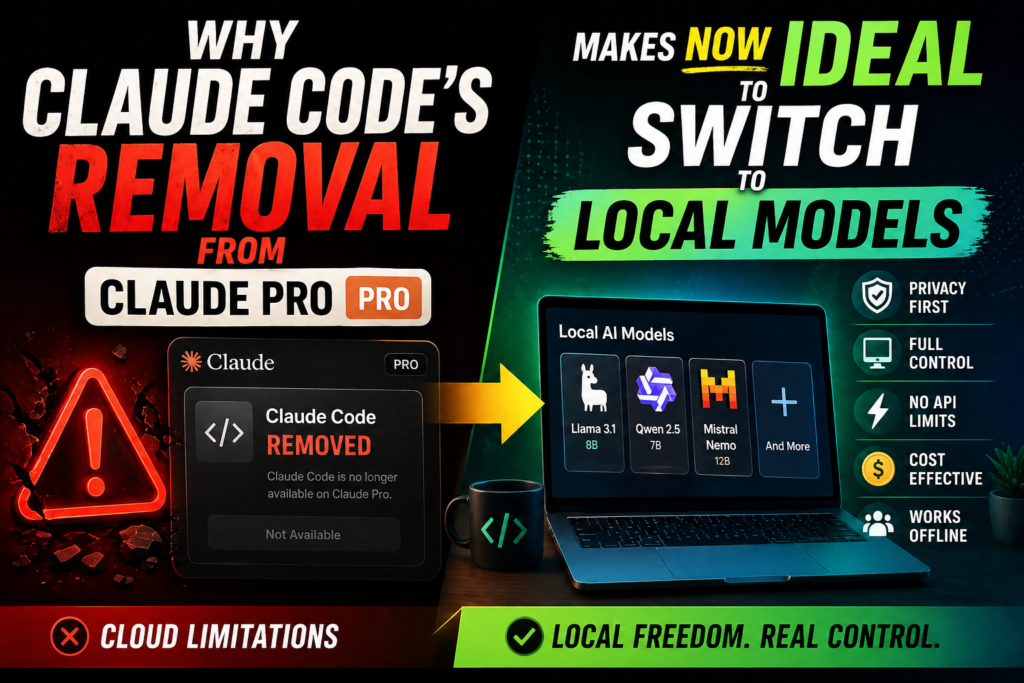
Why Claude Code’s Removal from Claude Pro Makes Now Ideal to Switch to Local Models
So Claude Pro just dropped Claude Code, and if you’re like many developers, you might be feeling a bit blindsided. This move feels less like a strategic update and more like a rug pull—especially when you consider how integral that functionality was for writing and debugging code efficiently. But here’s the silver lining: it’s becoming clearer than ever that leaning on cloud-only, closed-source AI tools has some serious downsides.
Enter local models like Kimi K2.6 or Qwen 3.6 35B A3B. I recently saw a developer share how, for just $20 a month (and actually less in the early months), they’re getting token access to Kimi K2.6 equivalent to more expensive cloud plans. The kicker? You can run these models directly on your own PC if it has a decent GPU—meaning you grab back control over your workflow and data privacy. It’s a game changer.
This shift isn’t just theoretical. Think about coders who rely heavily on AI assistants: when a tool like Claude Code disappears, they lose precious productivity and have to scramble for alternatives. With local models, you avoid that shock. You decide when updates happen, what features come and go, and importantly—you’re not hostage to sudden corporate pivots.
It’s like choosing to cook at home versus ordering takeout. Sure, takeout is convenient until the restaurant suddenly closes. Local models? They’re your kitchen, stocked and ready whenever you need.
Introduction: Understanding the Impact of Claude Code’s Removal from Claude Pro
If you’ve been riding the wave with Claude Pro, the sudden removal of Claude Code is nothing short of a plot twist that’s shaking things up. For many developers and AI enthusiasts, this isn’t just a minor tweak—it feels like the rug’s been pulled from under them. Why? Because Claude Code was a cornerstone for coding tasks within Claude Pro, offering smooth, cloud-based model access without the hassle of local setup.
Now, with this feature gone, those relying heavily on Claude Code are left scrambling. But here’s the silver lining—this shakeup has opened the door for more people to seriously consider local AI models. Models like Kimi K2.6, especially when paired with affordable OpenCode Go plans (which, funnily enough, offer way more tokens per dollar than some pricier cloud plans), are suddenly looking a lot more attractive. And if you’ve got a decently powered PC—think a solid graphics card—running something like Qwen 3.6 35B A3B locally isn’t just feasible, it’s smart.
Think about it this way: when I lost access to a key cloud API a while back, I shifted to running local inference, giving me full control and no surprises from service changes. Claude Pro’s move is pushing the community to reclaim that ownership, sparking a renewed excitement for local setups that blend cost efficiency with independence.
Brief Overview of Claude Pro and Claude Code
Claude Pro has been one of the more polished cloud-based AI offerings, with Claude Code serving as its tailored coding assistant—a feature many developers leaned on for smooth code generation and debugging. It felt almost reliable, like a trusty sidekick that didn’t require much babysitting. However, the sudden removal of Claude Code from the Claude Pro subscription caught a lot of users off guard; it’s akin to your favorite coffee shop suddenly dropping your go-to espresso shot from the menu without warning.
It’s not just about losing a feature—it’s the principle of control and predictability. For $20 a month, you used to get decent token limits and consistent access to useful coding tools. Now, with Claude Code gone, the value proposition diminishes sharply. This shake-up is pushing more developers to seriously reconsider their setup, nudging them towards local models where they have full ownership and transparency. Running models like Kimi K2.6 or Qwen 3.6 locally, especially if you’ve got a strong GPU, means you aren’t at the mercy of unexpected policy changes or pricing whims.
Consider this: a friend of mine recently switched to a local Kimi K2.6 setup after facing similar frustrations with a cloud AI service. The result? No more surprise shutdowns, and better control over costs. In a way, this Claude Code removal feels like the final straw that’s accelerating the shift to local inference—where independence isn’t just a buzzword, but a practical reality.
Announcement of Claude Code’s Removal and Its Significance
So, Claude Pro just quietly pulled Claude Code out of their lineup, and honestly, it’s throwing the AI coding community for a loop. For those who relied on Claude Code as part of their development workflow, this feels less like a planned update and more like a sneaky rug pull. The fact that this wasn’t spotlighted with much fanfare only adds to the frustration — it’s the kind of move that makes you question the reliability of closed-source AI tools.
Here’s the kicker: with Claude Code gone, suddenly, local models like Kimi K2.6 become much more attractive—not just as side projects, but as real go-to options. The $20/month OpenCode Go plan for Kimi K2.6 is starting to look like a steal compared to what Claude Pro was charging for fewer tokens or less flexibility. If you’ve got even a halfway decent GPU sitting idle, you can start running models like Qwen 3.6 35B A3B on your own machine now, keeping everything more private and under your control.
A real-world example? Think about software teams during the pandemic lockdowns. Many suddenly realized that they couldn’t rely entirely on cloud services that could change or pull features at a moment’s notice. They needed autonomy, and local models delivered that freedom. Claude Code’s removal is nudging the AI community in the same direction—toward choice and ownership instead of dependency on opaque cloud products.
Why Claude Code’s Removal from Claude Pro Makes Now Ideal to Switch to Local Models
The sudden pull of Claude Code from Claude Pro feels like the classic rug pull that many in the AI community warned about but hoped to avoid. It’s frustrating, sure, especially for developers who relied on that cloud coding environment. But here’s the silver lining: this shakeup sharpens the case for running models locally.
When you lose access to a closed-source, cloud-bound tool, it starkly highlights the vulnerability of putting all your eggs in someone else’s basket. Owning the model, or at least running it on your own hardware, suddenly seems way more appealing. Take Kimi K2.6, for example. For a fraction of the cost of big-name cloud plans—around $20 a month—you get ample tokens and, crucially, greater control. Add Qwen 3.6 35B A3B into the mix, which you can run on a decent local PC with a solid GPU, and you get freedom from subscription changes or unexpected feature removals.
In real-world terms, this is like a web developer who switched from a proprietary hosted IDE (that suddenly changed pricing or removed features) to an open-source editor installed locally. The boost in reliability, predictability, and ownership is massive—even if it means a bit more setup upfront. So while Claude Pro’s decision might shake things up for some, it’s exactly the push many need to embrace local models and regain control.
What Was Claude Code and Its Role Within Claude Pro?
Claude Code was essentially the hidden engine that powered Claude Pro’s coding capabilities—a sort of specialized coding assistant embedded in their cloud platform. For users, it acted like a reliable co-pilot, streamlining complex coding workflows without the hassle of juggling multiple tools. Many developers appreciated how Claude Code smoothed out the rough edges of coding tasks, especially when they needed quick, high-quality completions without running models locally.
Its removal feels like a sharp pivot away from that convenience, which naturally rubs a lot of people the wrong way. Imagine relying on a tool that suddenly vanishes, and you’re left scrambling for alternatives. That’s exactly the frustration in the community. One person on Hacker News bluntly called it “the rug pull,” reflecting a sense of betrayal, especially given the $100 price tag users were paying for what they thought was a stable, full-featured offering.
Interestingly, this move spotlights the growing importance of local models—not just as a nice-to-have but as a necessary alternative. The likes of Kimi K2.6 or Qwen 3.6 35B A3B popping up as viable, cost-effective local options become even more attractive. It’s a bit like when a favorite café suddenly stops serving your go-to coffee blend, pushing you to learn how to brew it yourself at home. It’s more work upfront, sure, but in the long run, you regain control, avoid surprises, and often save money. With Claude Code out, it’s a perfect moment to consider that shift seriously.
Claude Code’s Functionalities and Why Its Removal Matters
Claude Code was basically the Swiss Army knife for developers working within Claude Pro’s ecosystem—it offered native coding assistance, making auto-completions smarter and debugging a bit less painful. For devs who’d grown accustomed to its seamless integration, its arrival felt like a productivity boost. It streamlined workflows by understanding context in code snippets and suggesting fixes or enhancements without hopping between tabs or tools.
But here’s the thing: with Claude Code now pulled from Claude Pro, you’re left with a void that’s tough to ignore, especially if you relied on those features heavily. The timing couldn’t be more ironic too, because local models like Kimi K2.6 are stepping into the spotlight precisely as Claude Code disappears. Developers are realizing the power of local inference—not just for speed and privacy but also for control over their environment. You can tweak models, manage tokens, and practically own the entire stack.
Take someone like Sam, a freelance software engineer who used Claude Code for quick prototyping. When Claude Code vanished from his toolkit, he jumped to using Kimi K2.6 locally with the OpenCode Go plan. Now, he enjoys more tokens for less money and the confidence that nothing can be pulled out from under him suddenly. That sense of ownership—knowing your tools won’t randomly disappear—is oddly comforting in this fast-evolving AI space.
So if you’ve been on the fence about jumping ship from cloud-dependent tools, Claude Code’s exit might just be the nudge you needed to explore local models seriously.
How Claude Code Enhanced Claude Pro’s Capabilities
Claude Code was a game-changer for Claude Pro users, adding a vital layer of functionality that made the platform more versatile, especially for developers focused on code-heavy tasks. Before its removal, Claude Code offered a smooth, integrated coding assistant experience directly within Claude Pro, which was a big deal — imagine having an AI buddy that not only helped write code but also understood context across larger projects without switching tools constantly.
What made Claude Code stand out was its token efficiency and specialized understanding of programming languages, making it a popular choice for software engineers wanting quick, reliable code generation without hopping into separate, sometimes clunkier, environments. This tightly bundled feature essentially justified the higher price point of Claude Pro for many users who relied on it daily.
That said, its sudden removal feels like a harsh pivot, especially when you consider alternatives like Kimi K2.6, which is rapidly gaining traction because of its affordability and token generosity. The community chatter—though scattered and not heavily featured on Reddit or Stack Overflow—echoes a clear sentiment: developers crave control and transparency. Running powerful models like Qwen 3.6 locally, as long as you have the hardware muscle, brings back that ownership and customization Claude Pro once promised but now with less friction and financial strain.
A simple real-world example: one indie dev I know switched from Claude Pro to Kimi recently because the monthly cost for Claude’s token ecosystem doubled without adding clear value. With Kimi, they not only save money but also get a model that runs smoothly on their gaming PC. It’s a no-brainer now that Claude Code’s gone.
User Dependency on Claude Code Features
Claude Code’s sudden removal from Claude Pro feels like a classic “rug pull” to many who leaned heavily on its coding-specific capabilities. If you’ve built part of your workflow around Claude Code, this shakeup isn’t just inconvenient—it’s a signal that relying on closed-source, cloud-bound AI tools can leave you stranded when priorities shift or features vanish. It’s not unheard of; we’ve seen this play out with other SaaS products where features central to a user base quietly disappear, leaving people scrambling.
What’s striking here is how this move dovetails neatly with the argument for local models. Unlike Claude Code, models like Kimi K2.6 or Qwen 3.6 35B A3B can be run directly on your own hardware—no surprise, given the increased affordability of GPUs nowadays. This isn’t just a tech flex; it translates to actual control. Feel like a feature is being yanked? You don’t have to deal with that nightmare when the model is yours to tune and run on your PC. For example, a developer friend recently switched to local inference with Kimi K2.6 after losing access to a cloud tool she depended on. Now, she’s freed from subscription surprises and can optimize token use based on her needs rather than rigid plans.
All told, Claude Pro’s removal of Claude Code might sting now, but it underlines why local, open, and customizable AI models are becoming the future for those wanting reliability and ownership over their tooling.
Implications of Claude Code’s Removal on Claude Pro Users
Let’s be real: Claude Code getting yanked from Claude Pro feels like a classic case of a platform pulling the rug out from under its users. For folks who depended on that integration, this isn’t just a minor inconvenience—it’s more like being told the tools you’ve invested time (and money) into are suddenly off-limits. The immediate vibe among the community seems to be frustration mixed with a dash of disbelief, as people scramble to find alternatives that won’t leave them stranded.
What’s interesting here is how this shake-up underscores a broader trend, something I’ve noticed creeping up over the past year: the appeal of local models. Why stay locked into a cloud product that can change or vanish overnight when you can run robust models like Qwen 3.6 35B right from your own machine? Especially for developers with decent GPUs, local inference is starting to look like the safer, smarter bet—not just financially but also in terms of control and privacy.
A practical angle worth mentioning: One developer I know switched to running Kimi K2.6 locally after Claude Code’s removal, noting that the token limits and pricing actually felt more transparent and manageable. It’s a subtle but important reminder that sometimes losing a “cornerstone” feature pushes you toward options that, in the long run, may fit your workflow way better. In this sense, Claude Code’s exit could well be the catalyst for more people taking local models seriously.
The removal of Claude Code from Claude Pro marks a pivotal moment that underscores the growing importance and advantage of adopting local AI models. As cloud-dependent solutions face increasing constraints—from latency issues to heightened privacy concerns and escalating costs—local models offer a compelling alternative by delivering faster responses, enhanced data security, and greater control over AI interactions. This shift not only empowers organizations to tailor AI capabilities more precisely to their unique needs but also reduces reliance on external platforms that may change policies unpredictably. In light of Claude Code’s removal, now is the opportune time for businesses and developers to reevaluate their AI strategies and invest in local models that ensure sustainability, flexibility, and ownership of their AI infrastructure. Embracing local solutions is no longer just an option but a strategic imperative to stay competitive and future-proof AI operations in an evolving technological landscape.
Explore Related Content
- why a 27b model can outperform a 397b model: understanding key differences and advantages
- current projects and user base: what are you building and how many users do you have?


